How to Buy a Call Option: A Real Trade Walkthrough
What you are actually buying when you buy a call, how the pricing works, and how one contract compares to owning the stock.

You open the options chain for the first time, and you are staring at strikes, expirations, bids, asks, Greeks, and numbers everywhere.
Most beginners do not lose money on options because options are dangerous. They lose money because no one shows them how to structure the trade.
This walkthrough uses a real contract on Vertiv (VRT). Every screenshot below is a live snapshot from January 13, 2026, with VRT trading at $168.27 and 67 days left to the March expiration. I was bullish on VRT and took a position, though I structured it differently from the single call shown here. A single call is the cleanest way to learn the mechanics, so that is what I walk through. The prices are historical. The structure is not. At the end I show what this contract was worth at expiration.
Why structure matters more than direction
Options give you defined risk with asymmetric upside. That combination only works if the trade is built properly. Strike, expiration, entry price, and liquidity change the outcome as much as the direction call does.
What every call option contains
Three mechanics you need to hold in your head before the numbers.
All options expire. Unlike stocks, options do not last forever. Every contract has an expiration date, and after that date the contract no longer exists. You are not just taking a view on direction. You are taking a view on direction and time together.
All options have a strike price. The strike is the price at which you can buy or sell shares of the stock. If you own a $200 call and the stock later trades at $250, you hold the right to buy at $200. That is $50 per share of intrinsic value.
All options have a contract multiplier. This is where beginners get tripped up. If a stock trades at $120, one share costs $120. If an option is quoted at $5.00, you are not paying $5. You are paying $5.00 times 100 shares, or $500. Each contract controls 100 shares, so the quoted price is always multiplied by 100 to get the actual cost, called the premium.
If any of this feels unfamiliar, start with how equity options work and come back.
Why I use call options instead of buying stock
When I am bullish on a stock I have two choices. Buy shares, or buy a call.
I almost always choose the call, because it lets me risk less capital, control more upside, and define the downside before I enter.
The full reasoning behind position selection is in how to structure an options trade, and the company work that comes before it is in how to analyze a stock for an options trade.
The contract: Vertiv March $200 call
A call option gives you the right to buy a stock at a specific price within a certain timeframe. The VRT contract in this example:
Strike price: $200
Expiration: March 20, 2026
Contract price: $7.95
That means I control 100 shares of VRT, and I can buy them at $200 each even if the stock trades much higher later.
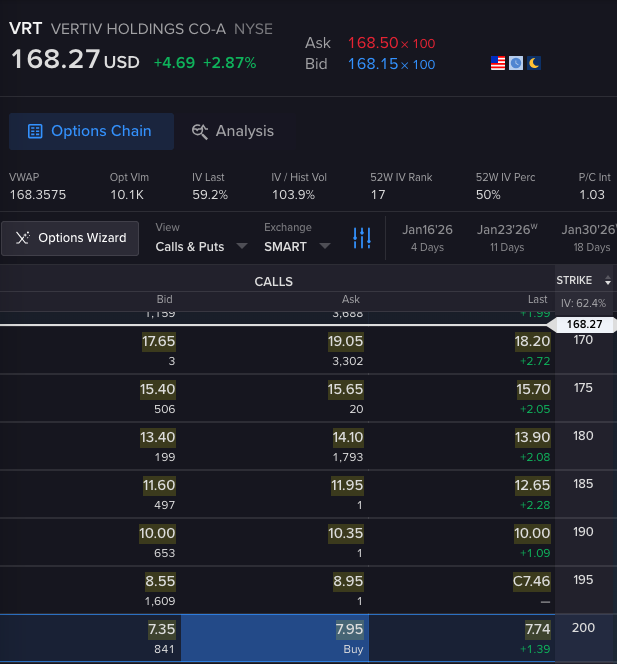
VRT options chain January 2026 showing the $200 call strike
You can choose different expirations. I use three months or longer. In this chain, March 20, 2026 sits 67 days out.

VRT option expiration selector with March 20 2026 at 67 days
How call option pricing works
Option prices are displayed in decimal form because they are quoted per share.
The contract costs $795 for 100 shares. Divide by 100 and you get the $7.95 quote.
To buy, you pay the ask, the higher of the two prices, $7.95. To sell, you receive the bid, the lower price, $7.35. So buying this contract at $7.95 costs $7.95 times 100, or $795. That $795 is the premium.
The spread is the silent killer
The difference between the bid and the ask is the spread.

VRT $200 call bid $7.35 and ask $7.95 showing a $0.60 spread
In this example the spread is $0.60, calculated as $7.95 minus $7.35. That is tight. I only trade options with a tight spread.
Here is why it matters. Imagine a wide spread instead:
You buy for $7.95, or $795. The bid is only $4.00, or $400. You have lost $395 the instant you enter, purely on the cost of exiting.
A wide spread means the position has to move significantly in your favour before you are even flat.
How to get a better fill
I always use limit orders at the mid price.
The mid is the price between the bid and the ask. In this example that is $7.65.
Be careful with brokers that advertise free trading. Some platforms are known for poor fills, which means you do not get optimal pricing and the platform profits from the spread.
The two Greeks that matter first
You do not need to memorise all of them. Two do most of the work early on.
Delta shows how much the option price moves when the stock moves $1. If delta is 0.31, a $1 move in the stock is roughly a $31 move in the contract, because the contract covers 100 shares.
Theta is time decay. If theta is displayed as -11.85, the position loses roughly $11.85 per day, all else equal. Because options expire, their value erodes as time passes.
This is exactly why I avoid very short dated options and prefer three months or longer. Short contracts force you to be right about direction and timing at once, and theta charges you rent while you wait.
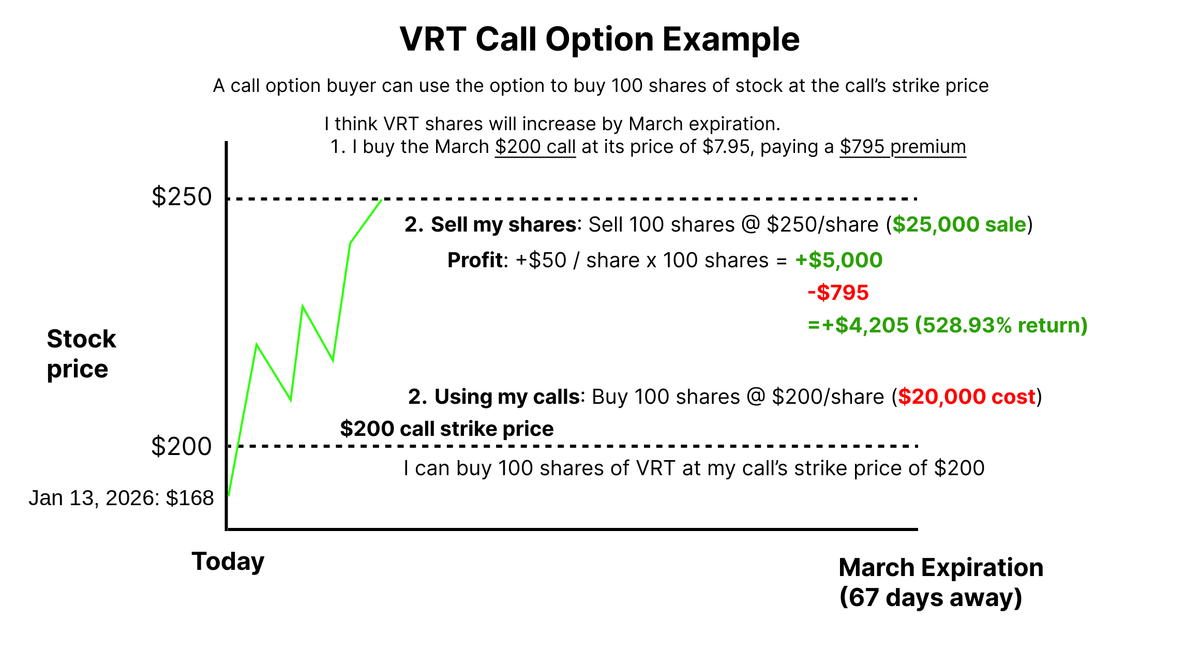
What the call option pays if VRT reaches $250
Buy the March $200 call at $7.95, for a total cost of $795.
If VRT rises to $250, the intrinsic value of the option is $50 per share.
Gross profit: $5,000, calculated as $25,000 sale value minus $20,000 purchase value
Minus premium: $795
Net profit: $4,205
Return: 528.93%
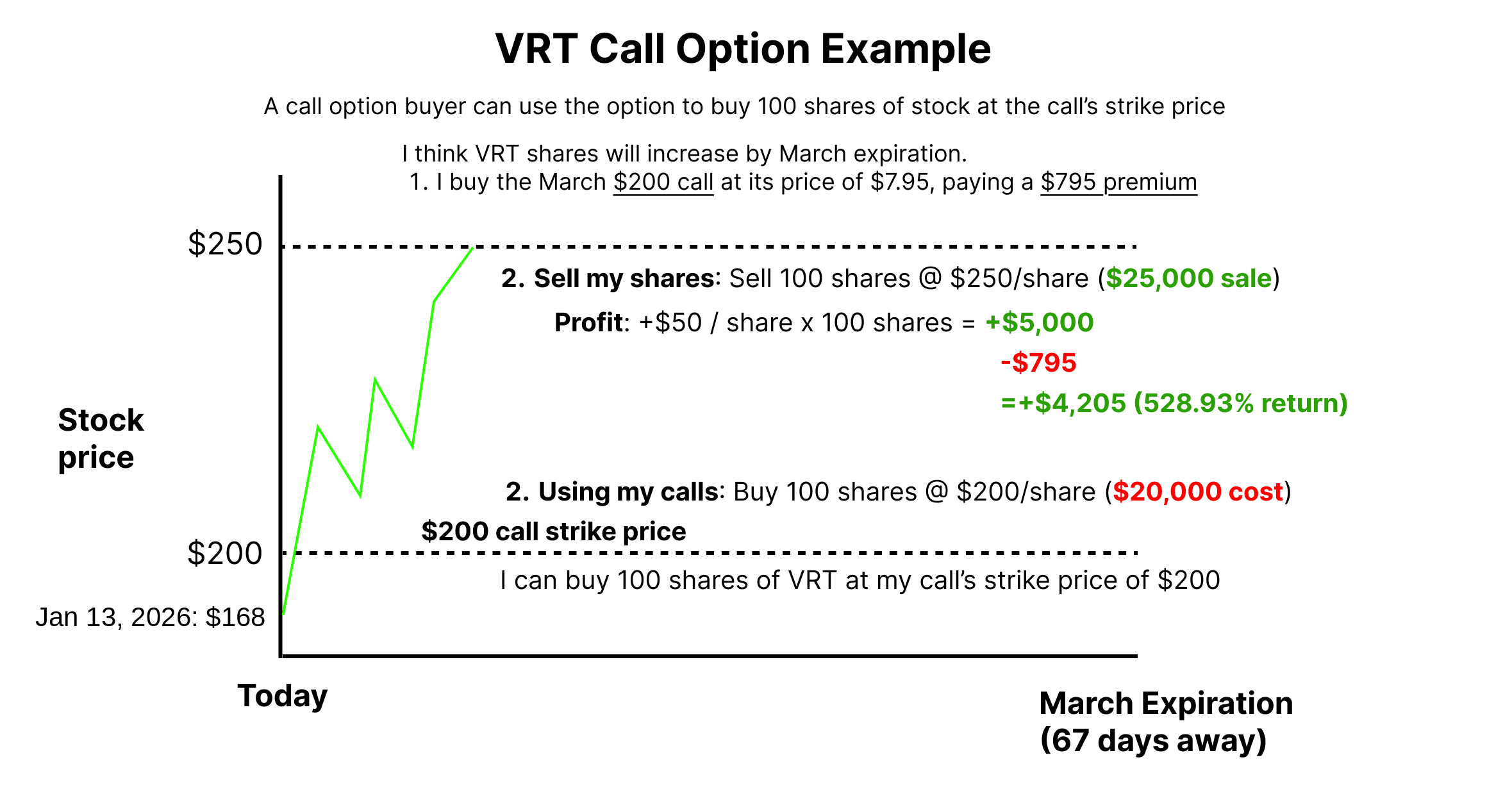
VRT call option payoff showing $4,205 net profit on a $795 premium
One point that beginners miss. You do not need to buy the shares. You can sell the contract itself and realise the $4,205 without ever needing the $20,000 in capital to exercise.
What actually happened
That $250 figure was a scenario, written in January. Here is what the contract did.
VRT ran hard through the first quarter. S&P Dow Jones Indices announced on March 9, 2026 that Vertiv would join the S&P 500 effective March 23, and the stock jumped 9.3% on the news. It set an all time high of $276.78 on March 11, then settled back to $255.83 at the close on March 20, the expiration date.
At that price the $200 call held $55.83 per share of intrinsic value, or $5,583 on the contract. Against the $795 premium, that is a net gain of $4,788, a 602.26% return.
Two honest observations about that outcome.
To be clear, this is what the contract was worth, not a return I am reporting. My own VRT position was structured differently, and every figure I do report is in the attested record.
The scenario was conservative and the position still needed a specific catalyst to work. Index inclusion was not in the January thesis. Most trades do not get handed one.
And the same structure that produced 602.26% would have gone to zero below $200. That is the trade. Defined downside, uncapped upside, and a premium you should be willing to lose in full.
Why this matters
This is not about hitting home runs on every trade. It is about limiting downside, structuring asymmetric bets, and letting winners run when volatility expands.
Structure is the part you control. Direction is the part you do not.
About the author
Iskandar Rakhmatov writes at Constellation Stocks. He runs a long/short equity options strategy, with calendar year returns verified by a U.S. licensed CPA.
Track Record | The Constellation Method
As a reader of Constellation Stocks, you agree to our disclaimer.