The Wheel Strategy for Options, Tested With Real Money
I have always been sceptical of the wheel. So I am running it with real money on one TTWO put, and I will report the result either way.

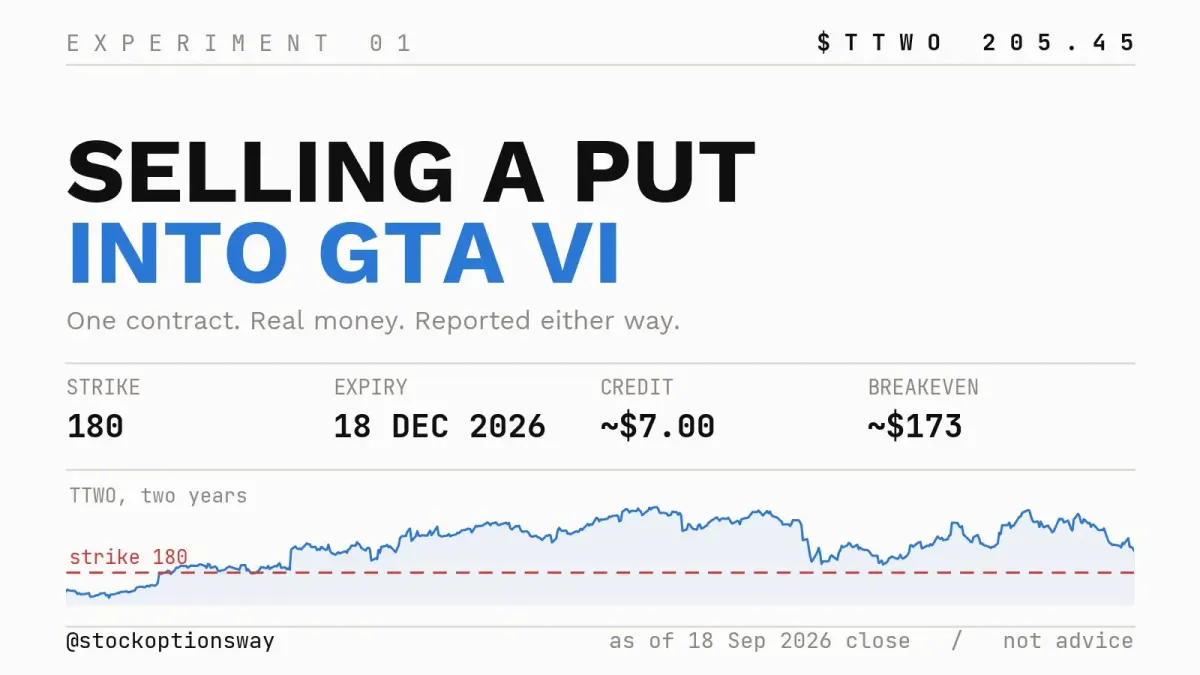
The wheel strategy is an options cycle of selling cash secured puts on a stock you would own, taking the shares if assigned, then selling covered calls until the shares are called away or sold. It earns premium. On September 21, 2026 I sold one TTWO December $180 put for $6.47: $647 of credit against $18,000 of collateral, about 15% annualized. This post shows how I picked the strike, what the trade really costs, and what I will do next.
Disclosure: I am short 1 TTWO December 18, 2026 $180 put, opened September 21, 2026. This is an educational record of my own trade, not a recommendation. Full disclaimer.
Key takeaways
- Trade: short 1 TTWO Dec 18, 2026 $180 put at $6.47. Credit $647, collateral $18,000, breakeven $173.53.
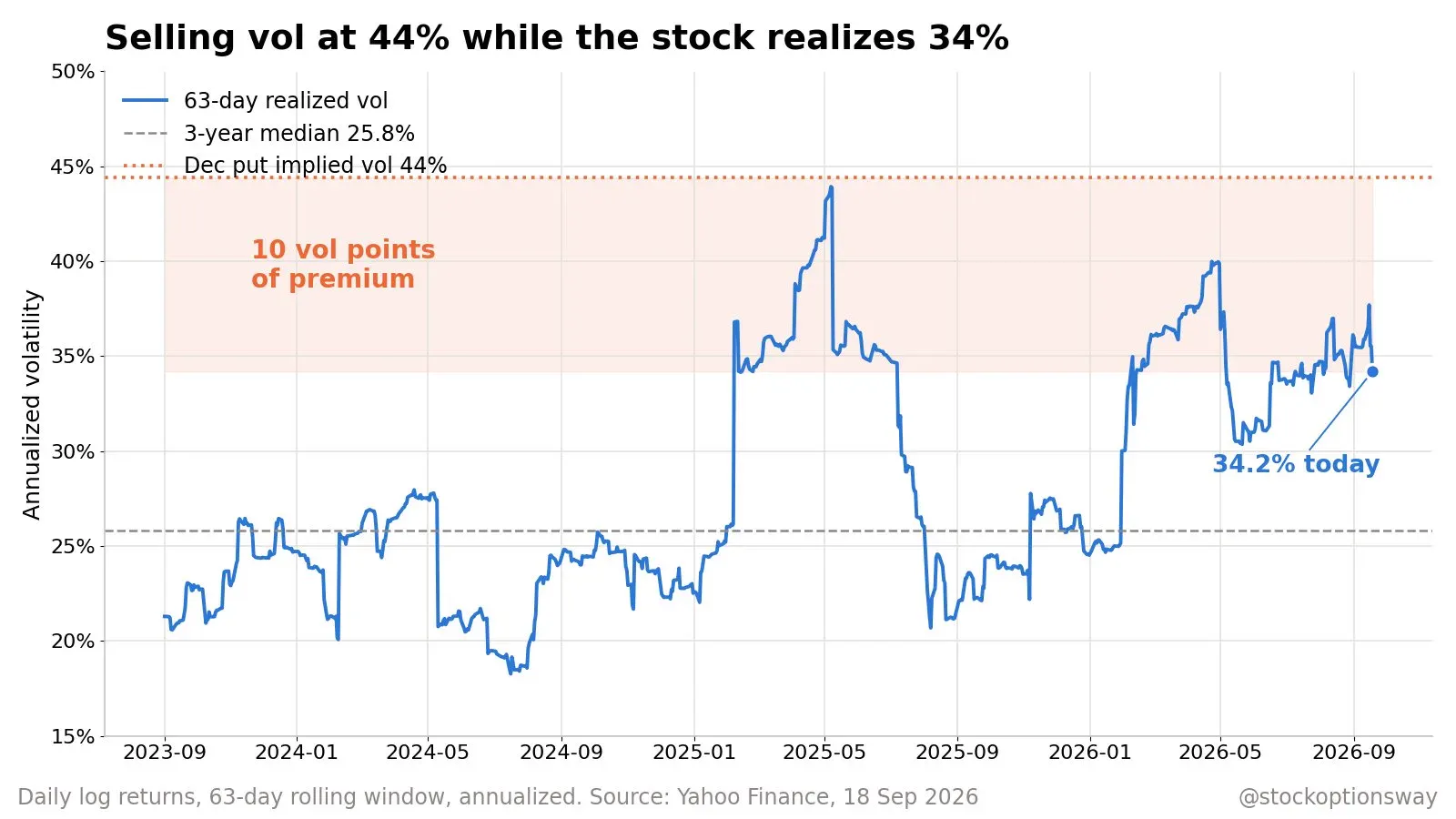
- Why the premium exists: December puts were priced at 44% implied volatility, while the stock realized 34% over the last 63 days. That 10 volatility point gap is the seller's potential edge, but only if the stock moves less than the market expects through earnings and the GTA VI launch.
- The trade off: at my fill the $180 put yields about 15% annualized, but the strike sits only 0.57 standard deviations below the $205.45 close on September 18. No strike gives both a high yield and a thick cushion.
- The hidden cost: the same $18,000 in 3 month Treasury bills would earn about $181 over the same 88 days, risk free. The real reward for taking stock risk is about $466, not $647.
- The plan: buy the put back under $1.00 any time after November 19. If assigned, my cost is $173.53 per share, and I judge the trade on that number.
What is the wheel strategy in options?
The options wheel is a three step income cycle built on one stock:
- Sell a cash secured put. You sell a put on a stock you would be happy to own, and you keep enough cash to buy 100 shares at the strike. You collect the premium up front.
- If assigned, take the shares. If the stock closes below the strike at expiry, you buy 100 shares at the strike. Your real cost is the strike minus every premium you have collected.
- Sell covered calls. You sell calls above your cost basis. When the shares are called away, or you sell them, the cycle restarts with a new put.
Income can come from three places: put premium, call premium, and any gain between your cost basis and the call strike or sell price. Dividends, if the stock pays one, are a fourth.
The best known practical guide to the method is the "Wheel (aka Triple Income) Strategy Explained" post on r/Optionswheel. Its core rules are worth knowing before you place a first trade:
- Pick stocks you would hold for months, not the highest premium on the screen.
- Sell puts around 30 to 45 days to expiry, near 0.30 delta.
- Take profits early, often at 50% of the credit.
- Roll a challenged put out in time and down in strike, but only for a net credit.
- Keep any one stock small, around 5% of the account, and hold a large cash reserve.
- Sell covered calls with strikes at or above your net cost, unless you have decided to exit the position at a loss.
Those rules describe the mechanics well. What most wheel content skips is the math behind the yield, which is what the rest of this post is about.
Why I am testing it
I have always been sceptical of the wheel. It is popular in retail right now, and most of the case for it is made with screenshots of winning weeks. So instead of arguing about it, I am running one position with real money and publishing every step, including if it goes against me.
This is one trade, not a backtest. It will not prove the wheel works or fails. It will show, with real fills, what the numbers look like from the inside.
The trade
| Item | Detail |
|---|---|
| Stock | Take-Two Interactive (TTWO) |
| Structure | Short 1 put, cash secured |
| Strike / expiry | $180 / December 18, 2026 |
| Opened | September 21, 2026, at the open |
| Fill | $6.47 per share ($647 credit) |
| Collateral | $18,000 |
| Breakeven | $173.53 |
| Return on collateral | 3.6% over 88 days, about 15% annualized |
| Estimated chance of assignment | About 30% |
| Spot when planned | $205.45 (September 18 close) |
I planned the trade on Friday, September 18 with an indicative credit of about $7.00. The quoted market was $6.60 bid, $8.00 ask. Monday's fill came in at $6.47. That gap matters: a $1.40 wide market is about 19% of the premium. On large caps you can work around it.
Why TTWO, and why now
Owning TTWO is not my base case. The base case is that the put expires worthless, or close to it, and I keep the premium. For that I wanted a stock with a catalyst ahead, and ideally one that had already been through a selloff.
A single product catalyst. GTA VI launches on November 19, 2026, and I expect the quarters after the launch to be strong. Fans could be disappointed, but early feedback does not point that way.
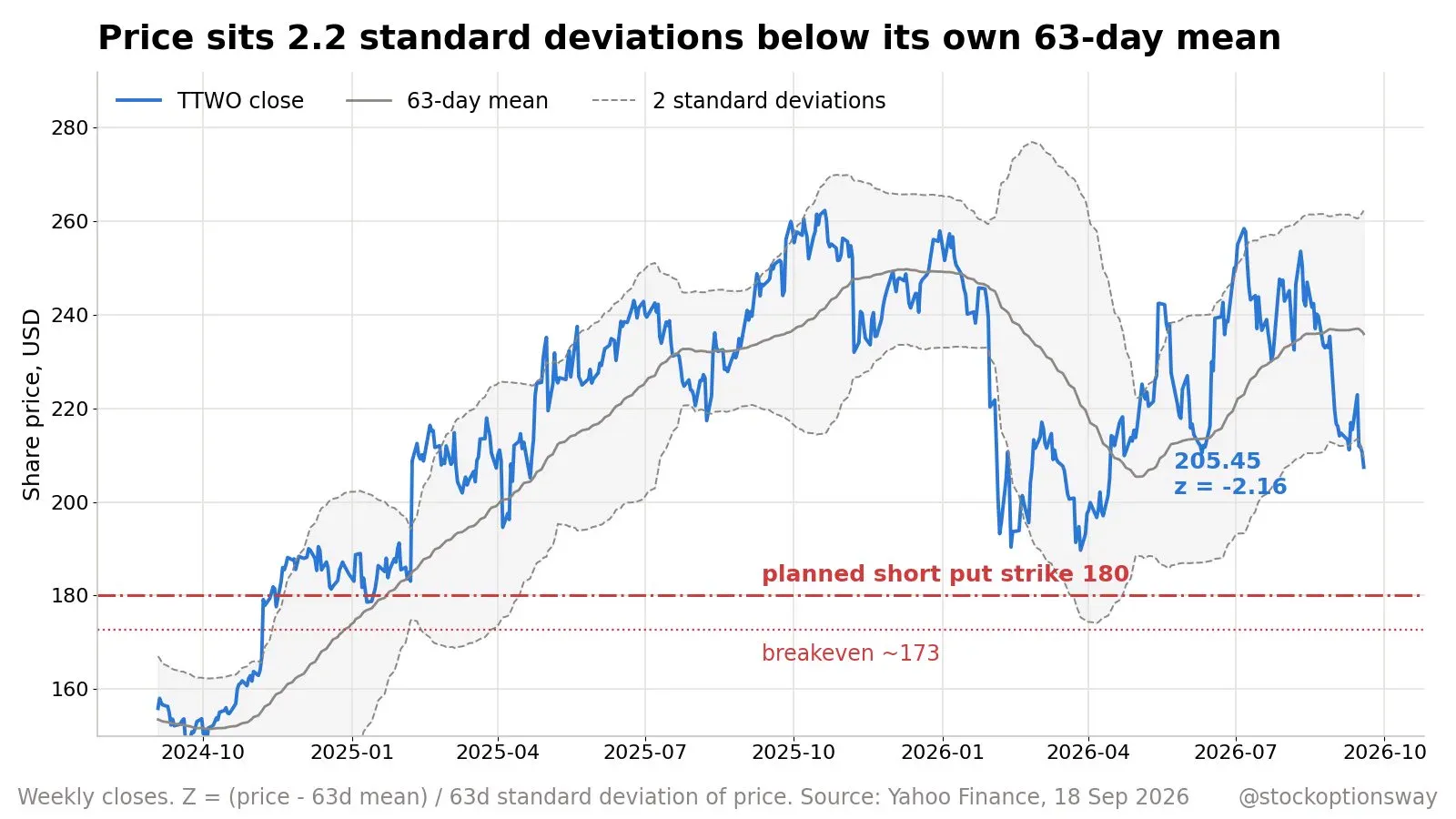
The stock had already been sold heavily. On September 18 TTWO was down 19.6% year to date and 20.9% below its 52 week high of $262. It closed at $205.45, 2.16 standard deviations below its own 63 day mean. In the last five years, only 4% of trading days were more stretched than this. That does not guarantee a bounce, but it means the put was sold after a drop, not after a rally.
Options were expensive relative to how the stock actually moves. The stock realized 34% annualized volatility over the last 63 days, already well above its 3 year median of 25.8%. December puts were priced at 44%. A put seller is paid when implied volatility is higher than what the stock goes on to realize. Here the market was paying about 10 volatility points for that.
The reason for the rich pricing is clear: a heavy event calendar sits inside the option's life.
| Date | Event |
|---|---|
| November 9, 2026 | Q2 FY27 earnings |
| November 19, 2026 | GTA VI launch |
| December 18, 2026 | Expiry |
Both events can move the stock hard in either direction. That risk is exactly what the premium pays for.
How I chose the strike
Every strike on the board is a trade off between yield and cushion.
With implied volatility near 45%, a one standard deviation move by December 18 is about 22.5%, which puts the stock near $160. My $180 strike is 0.57 standard deviations below spot.
- A $195 put yields about 25% annualized, with almost no cushion.
- A $160 put sits nearly a full standard deviation away, but yields under 7%.
- The $180 put sits in between: about 16% annualized, 0.57 sigma of cushion.
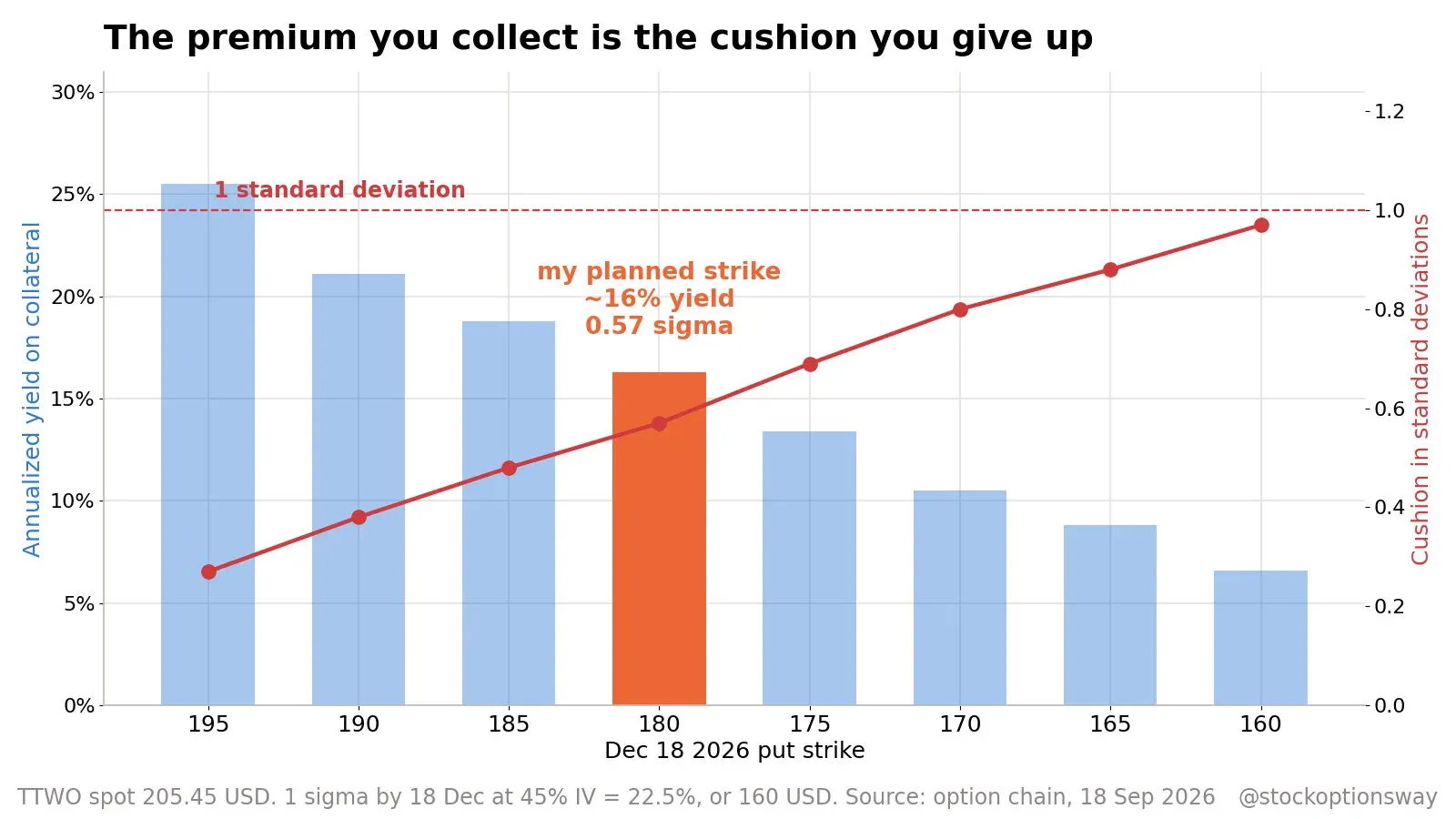
The yield looks good precisely because the cushion is thin. Most wheel posts quote the yield and skip the cushion. They are the same number seen from two sides.
The cost most wheel posts skip: capital
The wheel's real constraint is not the strike. It is that you must be able to take 100 shares. Here that means $18,000 locked up for 88 days to earn $647.
The fair comparison is not zero. It is what the same cash earns with no stock risk. On September 21, 2026 the 3 month Treasury bill yielded about 4.17%. Over 88 days, $18,000 in Treasury bills earns about $181.
| Amount | Annualized | |
|---|---|---|
| Put premium | $647 | about 15% |
| Treasury bill return on the same cash | about $181 | about 4.2% |
| Extra reward for taking stock risk | about $466 | about 10.7% |
Two practical notes:
- Many brokers let the collateral sit in Treasury bills or a money market fund while the put is open. If yours does, you earn both, and the premium is closer to pure extra return.
- If yours does not, the Treasury bill income is a real cost of running the wheel.
What happens at expiry
Here is the trade's profit or loss on December 18 at different prices, next to simply owning 100 shares bought at $205.45.
| TTWO at expiry | Short $180 put | 100 shares from $205.45 |
|---|---|---|
| $220 | +$647 | +$1,455 |
| $190 | +$647 | −$1,545 |
| $180 | +$647 | −$2,545 |
| $173.53 (breakeven) | $0 | −$3,192 |
| $160 (one sigma down) | −$1,353 | −$4,545 |
| $140 | −$3,353 | −$6,545 |
The put caps the upside at $647 and cushions the downside by $6.47 per share plus the $25.45 gap between spot and strike. It still loses real money in a large drop. The worst case, if the stock went to zero, is a loss of $17,353.
The plan from here
- Take profit early. I will buy the put back for under $1.00 any time after November 19. Once the GTA VI launch is behind the stock, implied volatility should fall. If the price holds, that drop should return most of the credit.
- If assigned, judge it on $173.53. Assignment means buying 100 shares at $180, but my real cost is $173.53. That is the number I measure the trade against, not the strike.
- After assignment, sell calls above cost. Following the wheel, I would sell covered calls with strikes above $173.53, so that if the shares are called away the full cycle closes at a profit.
- Report either way. I will update this post at the buyback window and at expiry, with the actual numbers.
When the wheel fails
The wheel works best on stable, liquid, profitable companies. It tends to fail in four situations:
- The stock falls and stays down. Premium does not offset a 40% drop. Stock selection matters more than the option.
- Impatience. Closing a challenged put for a big loss, or buying back a covered call at an inflated price, turns a slow recovery into a realized loss.
- Position size. One large assignment can freeze most of an account. Small positions across several stocks spread that risk.
- Thin option markets. Wide bid ask spreads and low open interest eat the premium. This is why the wheel is mostly a large cap strategy.
If you want to see how I think about options more broadly, start with how equity options work, then how to structure an options trade.
FAQ
Is the wheel strategy profitable? It can be, but the headline yield overstates it. On this trade, 15% annualized becomes about 10.7% after subtracting what the same cash earns in Treasury bills, and that extra return is payment for taking the risk of a large drop.
How much money do you need for the wheel? Enough to buy 100 shares at the strike for every put you sell. On this trade that is $18,000 for one contract. Most guides also suggest keeping each stock to around 5% of the account.
What delta and expiration should you use? Common guidance is 30 to 45 days to expiry at around 0.30 delta. I used 88 days at a strike 0.57 sigma below spot, because I wanted the option to span both the earnings date and the GTA VI launch.
What happens if you get assigned? You buy 100 shares at the strike. Your real cost is the strike minus the premium collected. Then you sell covered calls above that cost until the shares are called away.
Is the wheel safer than buying the stock? Somewhat. The premium and the lower strike give you a cushion, so a moderate drop hurts less than owning the shares. But below the strike you lose dollar for dollar like a shareholder, and if the stock rallies, your gain stops at the premium.
Does the wheel work on small cap or microcap stocks? Rarely. Option chains on small companies tend to have wide spreads and low open interest, so much of the premium is lost to trading costs, and the stocks are more likely to drop and stay down.
Updates
This section will be updated at the November 19 buyback window and at the December 18 expiry.
About the author: Iskandar Rakhmatov runs a long/short equity options strategy with his own capital, with calendar year returns verified by a U.S. licensed CPA. See the track record and the Constellation Method.
Educational content only. Not investment advice. Options involve substantial risk of loss. Past performance does not predict future results. Sources: TTWO prices and volatility from Yahoo Finance and the option chain as of September 18, 2026; 3 month Treasury yield from U.S. Treasury data via Alpha Vantage, September 21, 2026.