Bear Put Spread Calculator
By Iskan Rakhmatov, independent options portfolio manager
A bear put spread, also called a put vertical spread, buys one put and sells a lower strike put with the same expiry. It is a cheaper way to bet on a decline, with profit capped at the lower strike. Use the calculator to price the bear put spread option trade at your downside target.
What is a bear put spread?
A bearish options strategy with two puts. You buy a put at a higher strike and sell a put at a lower strike, with the same expiry. The put you sell pays for part of the put you buy. In return, you give up any profit below the lower strike.
How a bear put spread works
- Buy a put at the higher strike.
- Sell a put at the lower strike, same expiry.
- Net debit = long put price − short put price. That is your max loss.
- Max profit = (strike width − net debit) × 100 × contracts, reached at or below the lower strike at expiry.
- Breakeven at expiry = higher strike − net debit.
Bear put spread example
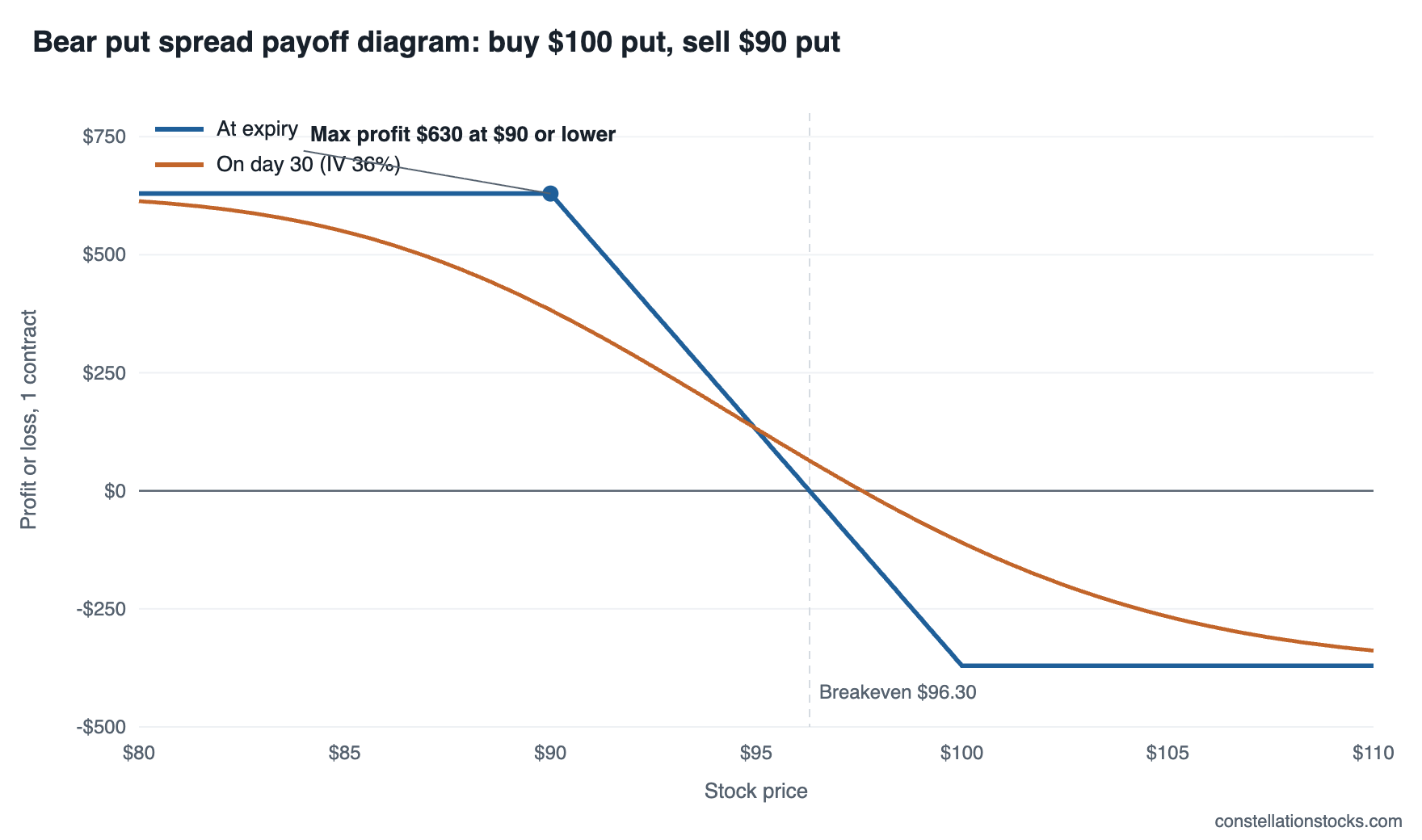
Stock at $100, 45 days to expiry, implied volatility 40%. Buy the $100 put, sell the $90 put. Net debit about $3.70, so one spread costs $370.
- Breakeven at expiry: $96.30
- Max profit: about $630, or 170% ROI, at $90 or lower at expiry
- At your target of $90 in 30 days, the spread is worth about $7.53: 103% ROI before expiry
The target test says Realistic: a fall to $90 in 30 days is 0.92 standard deviations.
Bear put spread payoff diagram
The payoff diagram has three parts. Above $100, both puts expire worthless and you lose the $370 debit. Between $100 and $90, the spread gains one dollar for each dollar the stock falls. Below $90, the profit stops growing at $630.
When the bear put spread strategy fits
On the short side of my book, I use a put vertical when puts are expensive. For example, after a stock has already started falling and implied volatility has jumped. The short put sells some of that rich volatility back and lowers the cost.
Same strike rule as on the long side: the short strike at the strike nearest my downside target, the long strike one or two strikes toward the current price.
Compare with a single put option to see what the cap costs you.
Risks and when to exit
- If the stock rises or stays flat, both puts lose value. The most you can lose is the net debit.
- Close at your target rather than waiting for the last dollar. Near the lower strike, the short put holds the spread below its max until expiry.
FAQ
Is a put vertical spread the same as a bear put spread?
Yes. With the higher strike put bought and the lower strike put sold, the put vertical is a bear put spread, also called a put debit spread.
What is the max profit on a bear put spread?
The strike width minus the net debit, times 100 times contracts, if the stock is at or below the lower strike at expiry.
What happens if the stock rises?
Both puts lose value. The most you can lose is the net debit.
Is a bear put spread a credit spread?
No. You pay to open it, so it is a debit spread. The credit version with puts is the bull put spread, which you open when you expect the stock to stay above the short strike.
Other calculators
- Options profit calculator
- Black Scholes calculator
- Call option calculator
- Put option calculator
- Bull call spread calculator
- Calendar spread calculator
- Diagonal spread calculator
See all of them on the free tools page.
Educational tool only. Not investment advice. Prices are Black Scholes estimates, not live quotes. See the Disclaimer.