Calendar Spread Calculator
By Iskan Rakhmatov, independent options portfolio manager
A calendar spread, also called a time spread, is an options strategy that sells a near term option and buys a later option at the same strike. It makes money from time: the near option loses value faster than the later one. Use the calculator for call or put calendars.
How a calendar spread works
- Sell an option with the nearer expiry.
- Buy an option with the later expiry, same strike, same type.
- Net debit = later option − nearer option. That is your max loss.
- Best outcome: the stock sits at the strike when the short option expires. The short expires worthless and the long still holds most of its time value.
- Worst outcome: a big move either way. Both options lose time value and the spread shrinks.
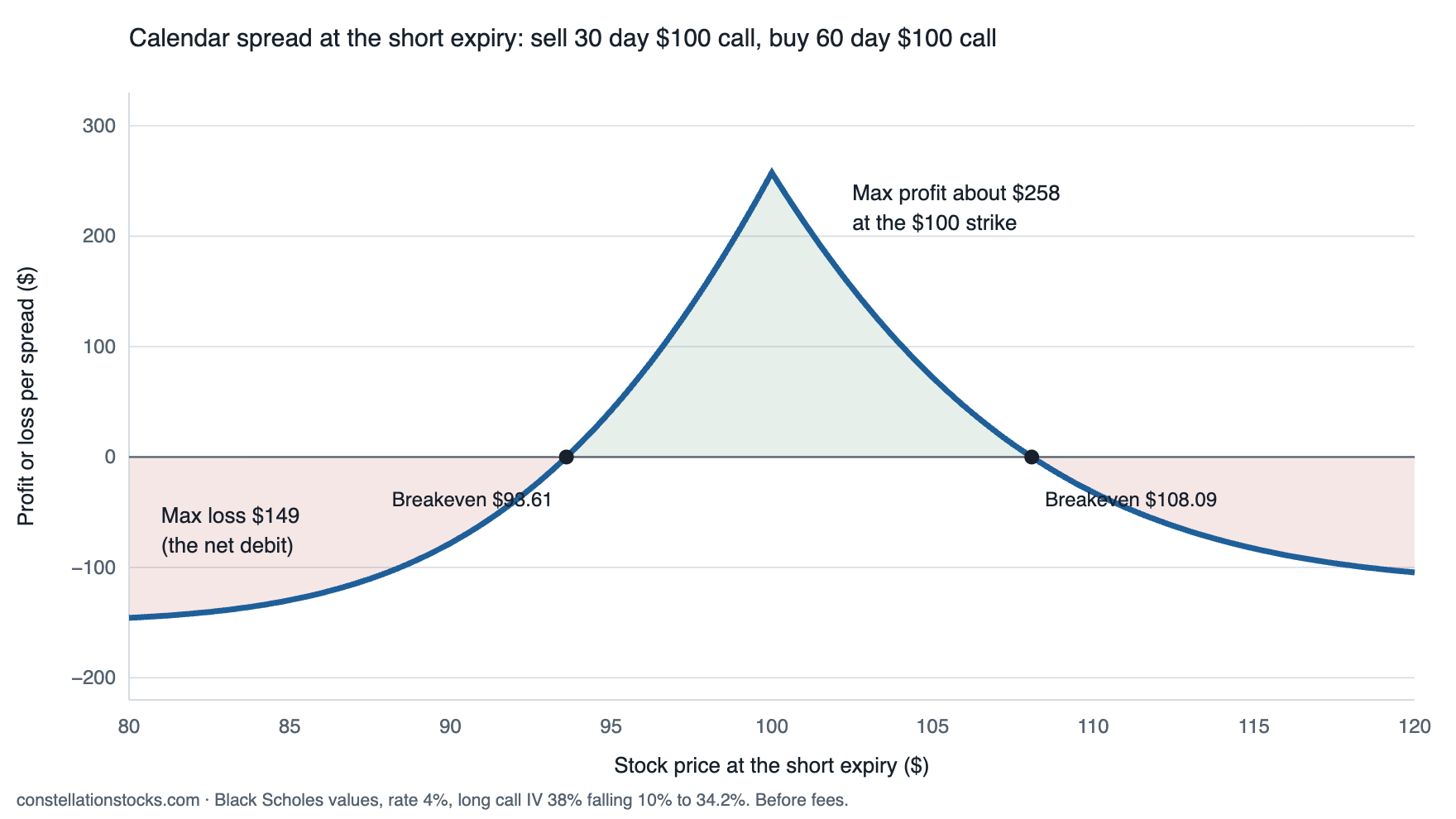
The payoff is a hill centered on the strike, with two breakevens, one on each side. The calculator finds both.
Example
Stock at $100. Sell the 30 day $100 call at IV 42%, buy the 60 day $100 call at IV 38%. Net debit about $1.50, so one spread costs $150.
Value at the short expiry, with the long call's IV down 10%:
| Stock at short expiry | Spread value | ROI |
|---|---|---|
| $90 | $0.72 | −52% |
| $100 | $4.07 | +172% |
| $105 | $2.22 | +48% |
| $110 | $1.17 | −21% |
Volatility matters more than direction
Two things drive a calendar beyond the stock price:
- Term structure. You want the near option's IV higher than the later one, which is common before earnings. Each leg has its own IV field in the calculator.
- IV change. The long leg is a long volatility position. If IV falls after you enter, the spread loses value even with the stock at the strike.
A calendar is neutral when the strike is at the money. Place the strike above the current price for a mildly bullish calendar, or below with puts for a mildly bearish one. The calculator shows the direction from your strike.
When a calendar spread strategy fits
- You expect the stock to stay near one price until the short option expires.
- The near option's implied volatility is higher than the later one's, which is common before earnings.
- You want a defined maximum loss, known before entry.
Double calendar spread
A double calendar spread is two calendars at once: a put calendar at a strike below the stock price and a call calendar at a strike above it. It widens the profit zone, so the stock does not need to sit right at one strike. In exchange it costs about twice as much, and the payoff has two peaks instead of one. To price one, run each calendar in the calculator and add the results.
Need a directional time spread? See the diagonal spread calculator.
FAQ
What is a calendar spread?
An options strategy that sells a near term option and buys a later option at the same strike. It profits from faster time decay in the near option, most when the stock is near the strike at the near expiry.
Is a calendar spread bullish or bearish?
Neutral at the money. With the strike above the current price it is mildly bullish; below it, mildly bearish.
What is the max loss on a calendar spread?
The net debit, assuming the short option is not assigned early.
Why is a calendar spread called a time spread?
Because the two legs differ only in time to expiry. The trade is a bet on how fast each one loses time value.
What is a double calendar spread?
Two calendar spreads opened together: a put calendar below the stock price and a call calendar above it. It profits if the stock stays between the two strikes, and costs about twice as much as a single calendar.
Is a calendar spread a good strategy before earnings?
It can be. Before earnings the near option usually has higher implied volatility than the later one, which helps the trade. The risk is a big move on the report and a drop in the long option's implied volatility after it, so size the trade so the full debit is a loss you accept.
Other calculators
- Options profit calculator
- Black Scholes calculator
- Call option calculator
- Put option calculator
- Bull call spread calculator
- Bear put spread calculator
- Diagonal spread calculator
See all of them on the free tools page.
Educational tool only. Not investment advice. Prices are Black Scholes estimates, not live quotes. See the Disclaimer.