Call Option Calculator
By Iskan Rakhmatov, independent options portfolio manager
Buying a call? Enter the strike, expiry, premium and your target. This call option calculator shows what your call is worth when the stock reaches your target. It also shows your profit, ROI and breakeven, and whether the target is realistic.
How a call option makes money
A call gives you the right to buy 100 shares at the strike price until expiry. You profit when the stock rises enough to cover the premium you paid. Your loss is limited to that premium. Buying a call is also called a long call, so this works as a long call option calculator too.
- Breakeven at expiry: strike + premium
- Max loss: premium × 100 × contracts
- Max gain: unlimited in theory
Before expiry the call also holds time value. That is why selling at your target often pays more than holding to expiry.
How to calculate call option profit
At expiry, any call option profit calculator does the same three steps:
- Value per share: stock price minus strike, or zero if the stock is below the strike.
- Profit: (value minus premium) × 100 × contracts.
- ROI: profit divided by what you paid.
Before expiry, this formula leaves out time value. The calculator adds it with the Black Scholes model. The example below shows how big that gap can be.
Example
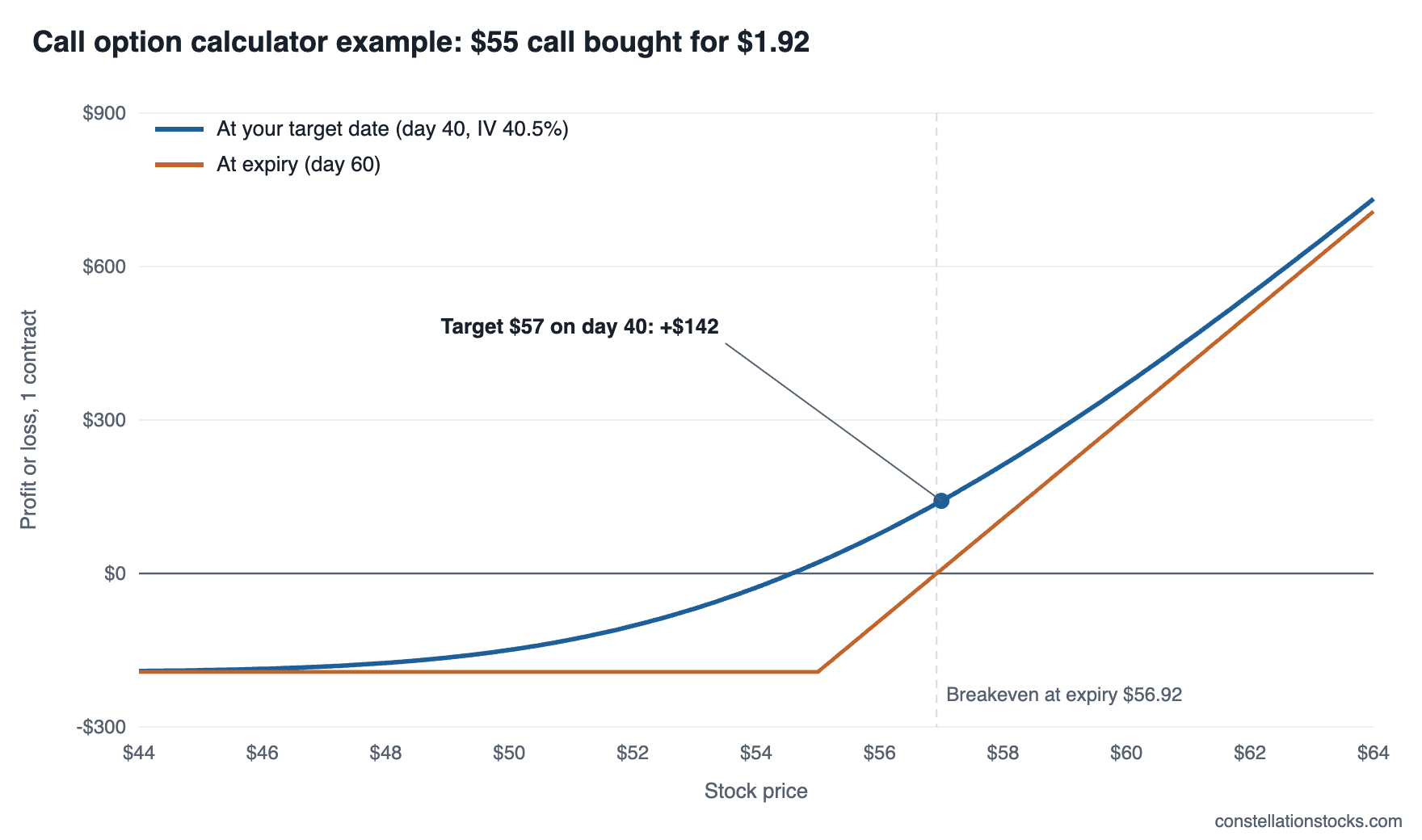
Stock at $50. You buy a $55 call expiring in 60 days, with implied volatility at 45%. Fair value is about $1.92, so one contract costs $192. Breakeven at expiry is $56.92.
Target: $57 in 40 days. If the stock gets there and implied volatility drops 10%, the call is worth about $3.34: a profit of about $142, or 74% ROI.
Held to expiry at the same $57, the call is worth only $2.00, a profit of $8. Selling on the target date keeps the time value still left in the option.
The target test says Realistic: $57 in 40 days is 0.88 standard deviations, with about a 38% chance of touching it.
Choosing the strike
- In the money calls cost more, move closer to the stock and need a smaller move to profit.
- Out of the money calls cost less and pay more in ROI, but need a bigger move in less time.
In my own book the long leg usually sits between 0.25 and 0.50 delta: enough leverage to pay well at the target, without needing the whole move to work. Try a few strikes in the calculator and compare ROI at your target, not just the price.
For limited upside at a lower cost, compare with the bull call spread calculator.
FAQ
What is a long call option?
Buying a call to open a position. You pay the premium and profit if the stock rises above the strike plus the premium. This calculator is built for long calls.
What is the breakeven on a call option?
Strike plus the premium paid, at expiry. A $55 call bought for $1.92 breaks even at $56.92.
Can I lose more than I paid for a call?
No. When you buy a call, the most you can lose is the premium.
Should I hold a call to expiry?
Not always. If the stock hits your target early, the call still has time value, so selling then often captures more than waiting.
Does this call options calculator work for puts?
No. For puts, use the put option calculator. For calls and puts in one place, and for spreads, use the options profit calculator.
Other calculators
- Options profit calculator
- Black Scholes calculator
- Put option calculator
- Bull call spread calculator
- Bear put spread calculator
- Calendar spread calculator
- Diagonal spread calculator
See all of them on the free tools page.
Educational tool only. Not investment advice. Prices are Black Scholes estimates, not live quotes. See the Disclaimer.