Bull Call Spread Calculator
By Iskan Rakhmatov, independent options portfolio manager
A bull call spread, also called a bullish call spread or call vertical spread, buys one call and sells a higher strike call with the same expiry. You pay less than for a single call, and in return your profit is capped at the higher strike.
How a bull call spread works
- Buy a call at the lower strike.
- Sell a call at the higher strike, same expiry.
- Net debit = long call price − short call price. That is your max loss.
- Max profit = (strike width − net debit) × 100 × contracts, reached at or above the higher strike at expiry.
- Breakeven at expiry = lower strike + net debit.
The short call pays for part of the long call, so the spread costs less and loses less to time decay and falling IV.
Bull call spread example
Stock at $100, 45 days to expiry, IV 40%. Buy the $100 call, sell the $110 call. Net debit about $3.53, so one spread costs $353.
- Breakeven at expiry: $103.53
- Max profit: about $647, or 183% ROI, at $110 or higher at expiry
- At your target of $110 in 30 days, the spread is worth about $7.20: 104% ROI before expiry
The target test says Realistic: $110 in 30 days is 0.83 standard deviations.
Bull call spread payoff diagram
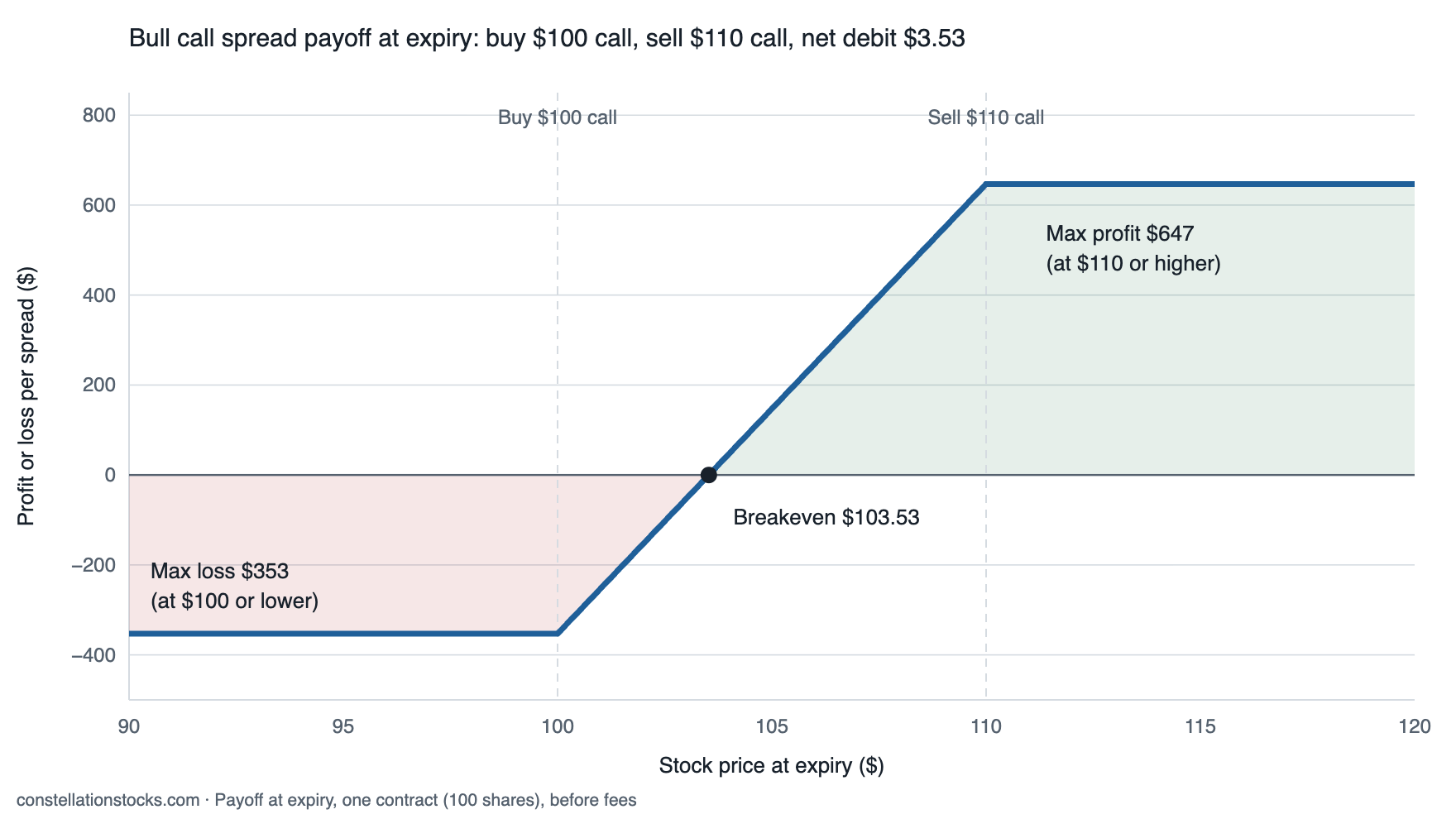
At expiry the spread has three zones. Below $100 both calls expire worthless and you lose the $353 you paid. Between $100 and $110 the spread gains $100 for every $1 the stock rises, crossing breakeven at $103.53. At $110 or higher the spread is worth its full $10 width, and profit stops at $647.
When to use a bull call spread
- You are bullish with a specific target, not open ended upside.
- Implied volatility is high, so a single call is expensive. The short call offsets part of that cost.
- You want a defined maximum loss, known before entry.
It fits less well when you expect a very large move, since gains above the short strike are given up.
Risks and how to exit
- Closing early: you can sell the spread at any time before expiry. Most traders close once most of the max value is reached, rather than holding to the last day.
- Early assignment: the short call can be assigned early, most often just before an ex-dividend date when it is deep in the money. Your long call still covers it, but check your account if it happens.
- Expiry between the strikes: if the stock closes between $100 and $110, the long call is exercised and the short call expires. You would hold 100 shares per spread on Monday. Close the spread before expiry to avoid this.
How I pick the strikes
I set the short strike at the strike nearest my target, and the long strike one or two strikes toward the current price. That way the spread reaches most of its max value right where I expect the stock to go, and I am not paying for upside beyond my thesis.
My rule of thumb: the spread should be able to make at least 200% if the target is hit. If it cannot, the target is too close or the spread is too expensive.
Compare with a single call option to see what you give up for the lower cost.
FAQ
What is a bull call spread?
A bullish options strategy: buy a call and sell a higher strike call with the same expiry. It costs less than a single call and caps both profit and loss.
Is a call vertical spread the same as a bull call spread?
Yes. "Vertical" means the two legs have different strikes and the same expiry. With calls bought at the lower strike, it is a bull call spread, also called a call debit spread.
What is the max loss on a bull call spread?
The net debit you paid, times 100 times contracts.
When is a bull call spread better than a long call?
When implied volatility is high or your target is specific. The short call cuts the cost, and you only give up gains beyond your target.
Can I close a bull call spread before expiry?
Yes. Sell the spread as one order: sell the long call and buy back the short call. Your profit is the price you sell it for minus the debit you paid.
Other calculators
- Options profit calculator
- Black Scholes calculator
- Call option calculator
- Put option calculator
- Bear put spread calculator
- Calendar spread calculator
- Diagonal spread calculator
See all of them on the free tools page.
Educational tool only. Not investment advice. Prices are Black Scholes estimates, not live quotes. See the Disclaimer.