Black Scholes Calculator
By Iskan Rakhmatov, independent options portfolio manager
Price a call or put option with the Black Scholes model. Use this Black Scholes options calculator to enter five inputs and get the fair value, the option Greeks, and the implied volatility behind a market price.
This online Black Scholes calculator is free, needs no sign up, and runs in your browser. It also works as an option price calculator and an option Greeks calculator.
What this Black Scholes model calculator gives you
- Fair value of a call and a put.
- The Greeks: delta, gamma, theta per day and vega per 1 point of volatility.
- Implied volatility: enter the market price of an option and the calculator solves for the volatility that produces it.
- Value at a target (optional): open the target fields to see what the option is worth at a future price and date, and whether that target is realistic.
Black Scholes inputs
| Input | What it means |
|---|---|
| Stock price | The current price of the stock |
| Strike price | The price at which the option lets you buy (call) or sell (put) the stock |
| Time to expiry | Days until the option expires, divided by 365 |
| Volatility | Implied volatility from the option chain, as a yearly percentage |
| Risk free rate | The yield on short term US Treasury bills, about 4% by default |
Option Greeks calculator
The calculator also works as an option Greeks calculator. Next to the fair value it shows the four Greeks used most in practice:
- Delta: how much the option price moves when the stock moves $1.
- Gamma: how much delta changes when the stock moves $1.
- Theta: how much value the option loses per day, all else equal.
- Vega: how much the option price moves when implied volatility moves 1 point.
The Black Scholes formula, and how the calculator uses it
For a call option:
C = S × N(d1) − K × e^(−r t) × N(d2)
For a put option:
P = K × e^(−r t) × N(−d2) − S × N(−d1)
Where:
- d1 = [ ln(S / K) + (r + σ² / 2) × t ] / (σ × √t)
- d2 = d1 − σ × √t
- S is the stock price, K the strike, t the time in years, r the risk free rate, σ the volatility
- N(x) is the standard normal cumulative distribution: the probability that a normal variable is below x
In plain words, the call value is the stock you expect to receive, minus today's value of the cash you expect to pay at the strike. Each part is weighted by how likely the option is to be used.
Example
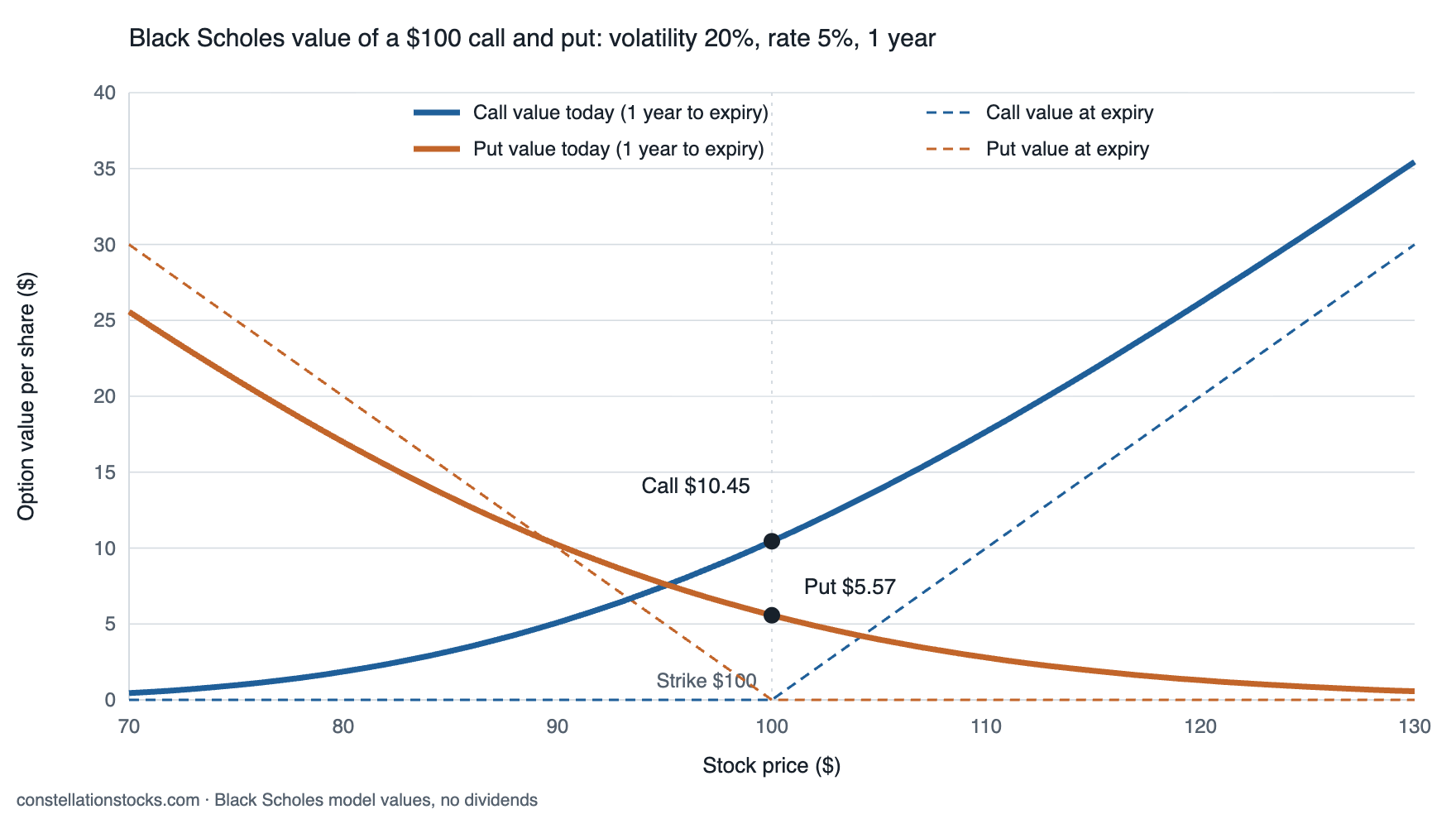
Stock price $100, strike $100, one year to expiry, volatility 20%, risk free rate 5%.
- d1 = (0 + 0.05 + 0.02) / 0.20 = 0.35, and d2 = 0.15
- Call value: $10.45
- Put value: $5.57
- Call delta: 0.64, so the call moves about $0.64 for each $1 move in the stock
You can check put call parity: call minus put = S − K × e^(−rt) = 100 − 95.12 = $4.88, and 10.45 − 5.57 = $4.88.
The Black Scholes model in brief
Fischer Black and Myron Scholes published the model in 1973. Robert Merton extended it the same year, which is why you also see the name Black Scholes Merton. It gave traders the first practical way to price options, and Scholes and Merton received the Nobel Prize in economics for it in 1997.
The model treats the stock price as a random walk with constant volatility. From that, it finds the price at which an option and a hedged position in the stock earn the same risk free return.
Black Scholes model assumptions
- Volatility and interest rates stay constant until expiry.
- Stock returns follow a lognormal distribution.
- The option is European: it can only be exercised at expiry.
- The stock pays no dividends during the option's life.
- No transaction costs, and trading is continuous.
None of these hold perfectly. Real volatility changes. The options market also prices bigger moves than a lognormal distribution suggests, which is why implied volatility differs by strike. Most US stock options are American, so early exercise can matter around dividends. Use the model as the market's common language for price, not as the truth.
How I use Black Scholes in practice
In my own long/short options book, I rarely use Black Scholes to find "cheap" options. I use it for two things:
- Pricing at the target. What is this option worth if the stock reaches my target price on my target date? That tells me if the structure pays enough.
- Testing the target. Implied volatility tells me how large a move the market expects. If my target is more than 1.5 standard deviations away, I move the target or give the trade more time.
The options profit calculator runs both steps for calls, puts and spreads. The full process is in the Method.
FAQ
What is a Black Scholes calculator?
A tool that computes the fair value of a European call or put option with the Black Scholes formula, from five inputs: stock price, strike, time to expiry, volatility and the risk free rate.
What volatility should I use?
Implied volatility from your broker's option chain, for the same strike and expiry. Historical volatility tells you how the stock moved in the past; implied volatility is what the market prices now.
Why does my broker show a different price?
Market prices include the bid and ask spread, dividends, early exercise and supply and demand. The calculator gives the model value. Enter the market price instead to see the implied volatility it implies.
Does Black Scholes work for American options?
It is an approximation. For calls on stocks that pay no dividends, early exercise is never optimal, so the value is the same. For puts and for stocks near a dividend date, American options can be worth a bit more.
What is implied volatility?
The volatility that, put into the Black Scholes formula, gives the option's market price. It is the market's estimate of how much the stock will move, as a yearly percentage.
What are the Greeks?
Sensitivities of the option price: delta, gamma, theta and vega. The option Greeks calculator section above explains each one.
Is this the same as a Black Scholes formula calculator?
Yes. It applies the Black Scholes formula shown above to your inputs, so you get the result without working through d1, d2 and the normal distribution by hand.
Is this an option value calculator?
Yes. Option value calculator, options price calculator and Black Scholes calculator usually mean the same tool: one that turns the five inputs into a fair value today. For what an option will be worth at a future price and date, use the options profit calculator.
Why is time to expiry entered as days divided by 365?
The Black Scholes formula uses time in years, so days to expiry become a fraction of a year. For example, 30 days is 30 / 365, or about 0.082 years.
What does it mean if my target is more than 1.5 standard deviations away?
The target needs a bigger move than the options market expects by the target date. In my process, that is a sign to pick a closer target or give the trade more time.
Other calculators
- Options profit calculator
- Call option calculator
- Put option calculator
- Bull call spread calculator
- Bear put spread calculator
- Calendar spread calculator
- Diagonal spread calculator
See all of them on the free tools page.
Educational tool only. Not investment advice. Prices are estimates from the Black Scholes model, not live quotes. See the Disclaimer.